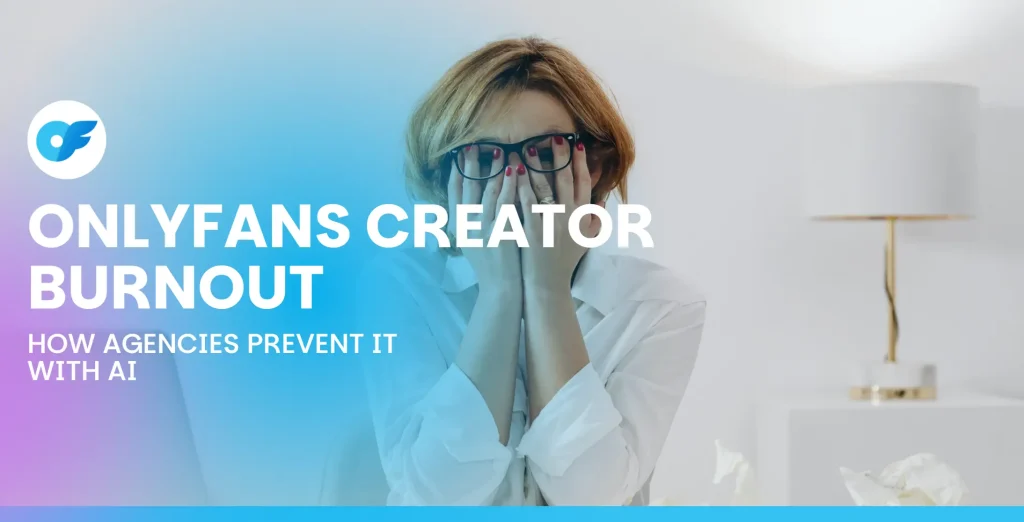
OnlyFans Creator Burnout: How Agencies Prevent It with AI
Creator burnout is one of the least-discussed and most consequential risks in the OnlyFans and Fanvue industry. It is also one of the primary reasons high-performing creators suddenly drop in output, churn from agencies, or leave the platform entirely. Understanding what causes burnout, how to recognise it early, and how to prevent it is not just good care for the creator — it is essential business risk management. BSilk‘s OnlyFans AI is one of the most effective burnout prevention tools available because it removes the most exhausting part of the job: managing hundreds of fan conversations every day.
- The primary driver of creator burnout is the relentless pressure of fan messaging — not content creation. Chatting volume is more exhausting than creative work for most creators.
- Burnout is a business risk, not just a wellbeing issue — burnt-out creators produce less, engage less, and churn from agencies at significantly higher rates.
- AI chatting removes the highest-volume, most repetitive, most draining part of the creator’s day — freeing them for creative work they find meaningful.
- Agencies have a direct financial incentive to prevent creator burnout — a creator who leaves ends the revenue relationship regardless of contract terms.
- Early warning signs are detectable through agency KPIs — content output decline, response time increases, and engagement quality drops all appear before the creator explicitly identifies burnout.
What Causes Creator Burnout on OnlyFans
Most discussions of creator burnout focus on content creation volume — posting pressure, production schedules, multi-platform demands. But for creators with an active subscriber base, the primary burnout driver is usually something else entirely: fan messaging.
Managing hundreds or thousands of individual fan conversations every day — many repetitive, some uncomfortable, all requiring emotional presence and persona maintenance — is extraordinarily draining. A creator maintaining their character in 200 simultaneous conversations, navigating difficult fans, handling custom requests, while maintaining the emotional availability that fans expect is doing work with no natural endpoint. Content creation, by contrast, happens in defined sessions. The messaging never stops.
Secondary burnout drivers include: platform policy anxiety, social media promotion fatigue, isolation, and the gap between public persona and private self. For agencies, recognising and addressing all of these is part of professional creator management.
The Burnout-Revenue Relationship
Creator burnout and revenue are directly correlated. When a creator is burning out:
- Content output declines — posts become less frequent, less creative, lower quality
- Fan engagement quality drops — messages become perfunctory, personality fades
- PPV performance falls — less engaged chatting means fewer conversions
- Subscriber churn increases — fans notice the quality decline
- Agency relationship strains — creator becomes less responsive, less cooperative
- Platform departure — in severe cases, the creator leaves entirely
The KPI that most reliably predicts burnout is content output rate. When a creator’s posting frequency drops without explanation, burnout is the most likely cause. Early intervention prevents the full cascade above.
Creator burnout is rarely sudden — it is a slow erosion that becomes visible in the numbers before it becomes visible in conversation. Agencies that read those numbers retain their best creators longest.
How AI Changes the Burnout Equation
BSilk’s OnlyFans AI removes the primary burnout driver — fan messaging volume — from the creator’s daily workload. When AI handles routine fan conversations, welcome sequences, PPV sends, and re-engagement sequences, the creator’s direct daily involvement in fan communication is dramatically reduced. Instead of 4-6 hours managing messages, a creator using BSilk might spend 30-60 minutes reviewing VIP conversations and creating content — while the AI maintains all other fan relationships at full quality.
This is not just an efficiency improvement — it is a structural change in how sustainable a creator’s career can be. Creators who spend 6 hours a day in their inbox burn out within 12-18 months of reaching scale. Creators whose AI handles the volume can sustain high performance much longer because the most exhausting element has been removed. For agencies, this translates to longer creator relationships, lower churn, and more stable revenue. See our guide on OnlyFans AI chatters for the full framework.
Agency Role in Burnout Prevention
- Content schedule boundaries: Agree a realistic content production schedule in the agency contract that does not require unsustainable rates.
- Communication boundaries: Clear agreements on when the creator needs to be available versus when the agency manages everything independently.
- Regular check-ins: Monthly conversations that explicitly ask about wellbeing and workload, not just business performance.
- Vacation provisions: Contractual provision for the creator to take breaks while the agency maintains the account with AI and chatters.
- Difficult fan filtering: The agency should filter and handle difficult fan interactions so the creator never has to deal with abuse or boundary violations.
Recognising Early Warning Signs
Signals to watch in your metrics dashboard:
- Content output declining below agreed schedule
- Creator response time to agency messages increasing
- Creator expressing frustration about messaging volume in check-ins
- Subscriber churn rate increasing without a clear external cause
- Declining engagement quality in creator’s personal VIP conversations
When two or more signals appear simultaneously, schedule an immediate check-in — not a performance review, but a genuine wellbeing conversation. The question is not “why is your output down” but “how are you doing and what can we take off your plate?”
BSilk removes the most draining part of the creator’s day — permanently.
When AI handles fan messaging, creators focus on what they love. Sustainable careers generate more revenue over more years than burnt-out ones.
Get a Free Demo →FAQ: Creator Burnout
Is creator burnout really that common?
Yes — it is one of the leading causes of creator churn from agencies and from the platform entirely. The majority of creators who manage significant subscriber bases without AI assistance report burnout symptoms within 12-18 months of reaching scale.
Can a creator recover from burnout?
Yes — with the right support and reduced workload. The key intervention is removing the primary stressor (usually messaging volume) and giving the creator time to recover. AI chatting is often what makes recovery possible — the creator returns at a reduced pace while the AI maintains the account.
What if a creator wants to be involved in their own messaging?
BSilk supports hybrid approaches — the creator can be as involved as they want. Many prefer to handle VIP conversations themselves while AI manages the volume. The goal is creator wellbeing and sustainability, not complete replacement of the creator’s role in their own account.
More on sustainable agency operations
How AI chatting removes the volume burden — and why the best creators embrace it.
The complete guide to building the agency infrastructure that prevents burnout from the start.
The KPI dashboard that surfaces burnout signals before they become creator exits.