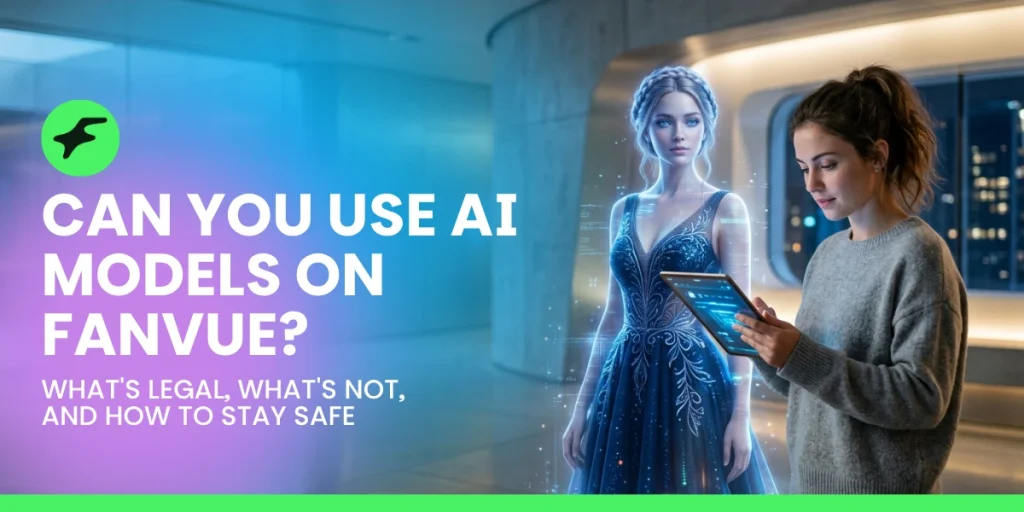
Can You Use AI Models on Fanvue? What’s Legal, What’s Not, and How to Stay Safe
Artificial intelligence is reshaping the creator economy — and Fanvue is one of the few adult platforms that has positioned itself explicitly at the center of that shift. AI models, virtual influencers, and automated chatting are no longer edge cases on Fanvue; they’re a recognized and growing creator category. But with that comes an important question: what’s actually permitted, what’s legally risky, and how do you operate AI models on Fanvue without crossing a line?
This guide covers the full picture — what Fanvue allows, where the legal boundaries sit globally, how to build a compliant AI model operation, and how BSilk fits into a professional hybrid setup.
- Fanvue permits AI-generated content and AI models — but requires clear disclosure and prohibits impersonation of real people.
- AI-generated intimate content depicting real people without consent is illegal in most jurisdictions and violates Fanvue’s terms.
- The legal test is simple: if it would be illegal to do with a real person, it’s equally illegal to simulate with AI.
- Agencies managing hybrid rosters — real creators alongside AI models — need separate account structures and clear compliance documentation.
- BSilk manages both real and AI creator accounts from a single dashboard, with AI chatting trained to maintain each persona’s distinct voice.
The Rise of AI Models on Fanvue
Fanvue has positioned itself as a next-generation alternative to OnlyFans, with an explicit focus on creator control and technological innovation. One of the most significant developments has been the emergence of AI models — virtual influencers and synthetic creators who post photos, chat with fans, and generate content powered by tools like Midjourney, Sora, and custom diffusion models.
Unlike traditional creators, AI models don’t exist physically. They are entirely digital personas built through generative AI tools. Some agencies now combine human creators with AI-assisted models — using realistic renders and AI-generated messaging to manage higher fan volumes and maintain engagement across more accounts than would be possible with human talent alone.
Fanvue acknowledges this category explicitly. According to their guidelines, AI-generated content is permitted — provided it is clearly disclosed, compliant with platform terms, and not misleading to users. That clarity is one of Fanvue’s genuine advantages over OnlyFans, where the rules around AI content are less defined and inconsistently enforced.
What Fanvue Allows — and What It Doesn’t
Fanvue permits AI-generated media — photos, videos, conversations — provided three conditions are met:
- Clear disclosure: Every AI-generated media must be identified as artificial. This means labeling in the creator’s bio, watermarks on content, and relevant hashtags. Fanvue’s moderation team checks both visually and through metadata.
- No impersonation: Using the likeness, name, or voice of any real person — celebrity, influencer, or private individual — without written consent is prohibited. This applies even to partial likeness: a composite face that resembles a real person without being an exact copy can still trigger a violation.
- Moderation compliance: AI content must pass what amounts to a “reasonable person” test. Misleading, non-consensual, or content that violates platform terms is removed regardless of whether it was AI-generated or human-created.
- Fully fictional AI model personas
- AI-generated photos and videos (disclosed)
- AI-assisted chatting and messaging
- Hybrid human + AI creator operations
- AI voice and persona automation tools
- Virtual influencer accounts with clear AI labeling
- AI content using real people’s likenesses without consent
- Non-consensual deepfakes of any individual
- Unlabeled AI content presented as human-created
- Content that could appear to depict a minor
- Using AI tools that prohibit adult content in their own ToS
- Fake engagement metrics generated by bots
The Legal Landscape for AI Adult Content
The legal environment around AI-generated intimate content is tightening rapidly. What was a gray area two years ago is increasingly defined by specific legislation across multiple jurisdictions.
The core legal distinction is between consensual synthetic content — where no real person is harmed, impersonated, or depicted without consent — and non-consensual deepfakes, which are now criminalized in most developed markets.
Legislation moving quickly in this space includes the U.S. Take It Down Act, the UK’s Online Safety Act provisions on intimate image abuse, and equivalent legislation in Australia, Canada, and across the EU. The common thread: creating or distributing intimate synthetic media that depicts a real person without their consent is now a criminal offense in most of the markets where Fanvue operates.
The legal test is straightforward: if it would be illegal to do with a real person, it is equally illegal to simulate with AI.
Creating and monetizing AI models is legal when:
- The model is a fully fictional character not based on any real person
- The creator owns or has explicit permission for all assets used — faces, voices, visual styles
- The content is labeled as AI-generated to avoid misleading users
- The AI tools used permit adult content under their own terms of service
It becomes legally problematic when:
- Any likeness belongs to a real person who hasn’t given explicit written consent
- The AI tool used prohibits adult content — using it anyway violates both the vendor’s ToS and potentially platform terms
- Generated content could be interpreted as depicting a minor, even if entirely synthetic
- Content is designed to mislead fans about whether they are interacting with a human or AI
How to Build a Compliant AI Model Operation on Fanvue
Operating AI models on Fanvue professionally requires more than creative output — it requires process and documentation. The following framework covers the most important compliance steps.
Disclose visibly and consistently
Every AI model account must identify itself clearly. “AI Model” in the bio, relevant hashtags on content (#AICreator, #AIGenerated), and watermarks where appropriate. This is both a Fanvue requirement and a meaningful trust signal for fans — the Fanvue audience that engages with AI models generally expects and accepts the disclosure.
Keep consent documentation
If any real likenesses or voices are used — even partially — obtain written consent and store it systematically. Fanvue can request proof of consent at any time, and agencies managing multiple AI model accounts need a documentation system rather than ad hoc records.
Verify your AI tools’ terms of service
Tools like Midjourney, Sora, and Runway each have their own policies on adult and NSFW content — policies that differ from Fanvue’s. Using a tool that prohibits adult content to generate adult content violates the vendor’s ToS regardless of what Fanvue allows. Verify each tool’s current terms before using it for AI model content generation.
Separate AI and human accounts clearly
Agencies managing both real creators and AI model accounts should maintain clear separation between them — distinct account structures, separate content pipelines, and no mixing of AI-generated and human-created content within the same account without disclosure. This protects both the real creators and the AI model operation.
Monitor policy changes proactively
Fanvue’s guidelines on AI content are evolving, and legislation in this space is moving quickly. Review Fanvue’s acceptable use policy regularly — particularly before deploying new content types or AI tools. What is permitted today may require updated disclosure or approach within a year.
Manage real and AI creator accounts from one dashboard.
BSilk handles AI-assisted chatting, fan classification, and PPV automation for Fanvue and OnlyFans — across real and virtual creator accounts.
Get a Free Demo →How BSilk Fits Into an AI Model Operation
Running multiple AI or hybrid creator accounts manually becomes operationally complex quickly — tracking fan interactions across personas, maintaining consistent voice for each AI model, managing PPV campaigns, and ensuring compliance documentation is current across accounts. This is where BSilk provides the operational layer that makes scale manageable.
BSilk handles the following for agencies running AI model operations:
- AI-assisted chatting with per-account voice training — each AI model maintains its own distinct tone, persona, and conversational style. Fans receive consistent interactions regardless of which account they’re engaging with.
- Fan interaction tracking across all accounts — the CRM logs every fan interaction, purchase, and engagement signal across real creator and AI model accounts in a single dashboard.
- PPV automation and targeted upsells — behavior-triggered PPV offers and upsell sequences run automatically for each creator persona, maintaining the narrative and content strategy appropriate to each AI model’s positioning.
- Unified management for real and virtual creators — agencies don’t need separate tools for human creator accounts and AI model accounts. BSilk handles both natively under one dashboard.
FAQ: AI Models on Fanvue
Are AI models allowed on Fanvue?
Yes. Fanvue explicitly permits AI-generated content and AI model creator accounts, provided they are clearly disclosed and compliant with platform terms. This is one of Fanvue’s clearest differentiators from OnlyFans, where the rules around AI content are less defined.
Do I have to disclose that my creator is an AI model?
Yes — Fanvue requires disclosure. This means labeling the account as an AI model in the bio, using appropriate hashtags on AI-generated content, and not presenting AI personas as human creators. Non-disclosure risks account removal regardless of content quality.
Can I use a real person’s face to create an AI model?
No — not without explicit written consent from that person. Using any real person’s likeness, voice, or name without consent violates both Fanvue’s terms and applicable laws in most jurisdictions. The legal risk is significant and increasing as legislation in this space tightens.
Can my AI chatbot pretend to be a human on Fanvue?
This is a nuanced area. Using AI to maintain a fictional creator persona is generally permitted — Fanvue fans engaging with an AI model account understand they’re interacting with a synthetic persona. Actively claiming to be human when a fan sincerely asks is a different matter and risks both platform violations and consumer protection issues in some jurisdictions.
How do I manage multiple AI model accounts efficiently?
The same way you’d manage multiple human creator accounts — with a CRM and AI chatbot that handles each account’s fan interactions while maintaining the distinct voice and persona of each creator. BSilk manages multiple Fanvue accounts natively, with per-account voice training that keeps each AI model’s persona consistent across all fan interactions.
What happens if Fanvue’s AI policy changes?
Monitor Fanvue’s acceptable use policy page directly and subscribe to platform communications. Policy changes in this area tend to give creators a transition period rather than immediate enforcement — but agencies that stay current with policy updates are in a much better position than those that don’t.
Running AI models on Fanvue? BSilk makes it scalable.
Fan classification, per-persona AI chatting, PPV automation and CRM — for real creators and AI model accounts alike.
Get a Free Demo →More guides for Fanvue creators and agencies
How the platform works, how it compares to OnlyFans, and what creators actually earn on Fanvue.
Team structure, CRM configuration, AI chatting and performance tracking for Fanvue agency operations.
How to build a chatbot and automation system that handles Fanvue fan conversations at scale.